Skip to content. Check and Connect

Located at the Institute on Community Integration, a University Affiliated Program on Developmental Disabilities

College of Education and Human Development, University of Minnesota

Funded by the Office of Special Education Programs, US Department of Education

The Check & Connect Model

Introduction

Check & Connect is a structured intervention that helps schools and organizations identify students who are at risk for dropping out of school, then pairs those students with mentors who address each student’s individual needs to help them progress toward school completion.

Check & Connect is used with students as young as elementary school and as old as late high school. Each implementation of Check & Connect is tailored to the school or site where it is used, with the goal of making a long-term commitment to the students served. Participating sites purchase two days of initial training sessions to implement the program, as well as program materials to work with staff and students.

Demonstrated outcomes of Check & Connect implementation include:

  • decrease in truancy,
  • decrease in dropout rates,
  • increase in accrual of credits,
  • increase in school completion, and
  • impact on literacy.

Research-based

The Check & Connect model originated from a partnership of researchers, practitioners, parents, and students led by the Institute on Community Integration, University of Minnesota. The model is data-driven and grounded in research on resiliency and home-school collaboration. Student referral criteria include alterable warning signs of school withdrawal – primarily attendance indices (absences, tardies, or skipping class) – in the context of academic performance and emotional or behavioral problems.

Check & Connect focuses on building protective factors by promoting resiliency through a mentoring-type approach, competency through a cognitive-behavioral approach, and home-school collaboration through family-centered practices.

Check & Connect is one of 28 dropout prevention interventions reviewed by the U.S. Department of Education, Institute of Education Sciences' What Works Clearinghouse to date, and the only one found to have positive effects for staying in school.

How It Works

Check & Connect is implemented by a person referred to as a mentor. The person is a cross between a mentor, an advocate, and a service coordinator whose primary goal is to keep education a salient issue for disengaged students and their teachers and family members. The mentor works with a caseload of students and families over time (for at least two years) and follows them from program to program and school to school.

Check & Connect is structured to maximize personal contact and opportunities to build trusting relationships. Student levels of engagement (such as attendance, grades, and suspensions) are “checked” regularly and used to guide the mentors’ efforts to increase and maintain students’ “connection” with school.

The Four Components of Check & Connect

  1. A mentor who keeps education salient for students
  2. Systematic monitoring (the “check” component)
  3. Timely and individualized intervention (the “connect” component)
  4. Enhancing home-school communication and home support for learning

The Core Elements of Check & Connect

  • Relationship Building—mutual trust and open communication, nurtured through long-term commitment focused on students’ educational success.
  • Routine Monitoring of Alterable Predictors—systematic check of warning signs of withdrawal (attendance, grades, suspensions) using data readily available to school personnel.
  • Individualized and Timely Interventions—support tailored to individual student needs, based on level of engagement with school, associated influences of home and school, and the leveraging of local resources.
  • Long-term Commitment—committing to students and families for at least 2 years, including the ability to follow mobile youth from school to school.
  • Persistence Plus—persistent source of academic motivation, continuity of familiarity with youth and family, and consistency in the message that “education is important for your future.”
  • Affiliation with School and Learning— facilitate students' access to and active participation in school-related activities and events.
  • Problem-solving and Capacity Building—promote the acquisition of skills to resolve conflicts constructively and to look for solutions—avoid the tendency to place blame and diminish potential to create dependency.

Steps to Implement Check & Connect

  1. Determine indicators of students’ disengagement
  2. Identify students at risk of disengagement or dropout
  3. Select/hire mentors
  4. Use “check” procedures to monitor students
  5. Organize existing resources for intervention
  6. Implement “connect” procedures based on student needs as discerned in Step #4
  7. Provide mentor support and supervision
  8. Evaluate program implementation

Training and Technical Assistance

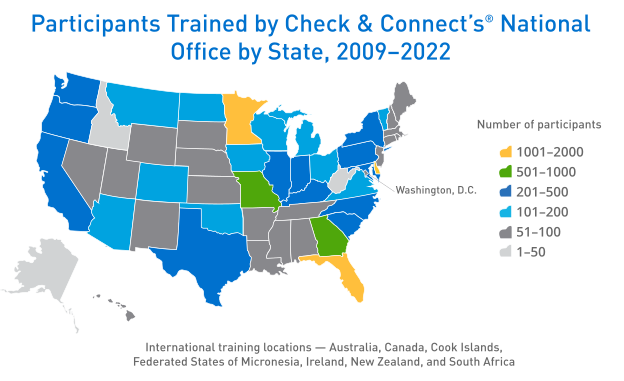
Check & Connect trainers conduct training on the model and its implementation either in Minneapolis, Minnesota (see Check & Connect Training) or at your site, aligned to your needs, for teachers, administrators, counselors, parent liaisons, and others as invited (maximum 50 participants). This training provides participants with practical tools for helping students reconnect to school and get on track to graduation, and complements the Check & Connect manual, Check & Connect: A Comprehensive Student Engagement Intervention (2008).

Trainers can also be contracted to provide follow-up technical assistance to training participants. Each participant receives a copy of the new Check & Connect manual.

If you'd like to gain more information about Check & Connect training, to see if it meets your needs and the needs of your students, please answer some questions in our Training Inquiry Form or contact us at checkandconnect@umn.edu or toll-free at 866-434-0010.

Check & Connect Manual

cover

Check & Connect: A Comprehensive Student Engagement Intervention Manual

By S. L. Christenson, M. L. Thurlow, M. Fox Sinclair, C. A. Lehr, C. M. Kaibel, A. L. Reschly, A. Mavis, and A. Pohl

The implementation manual for Check & Connect, a comprehensive, targeted intervention designed to enhance students’ engagement at school and with learning through relationship building and problem solving. The 2008 edition of the manual, which expands and updates the original 1995 manual, outlines the key components of Check & Connect, describes the steps to implement this research-based model, and presents the theory underlying the intervention. (2008)

Cost of Manual

$45.00 each (1-19 copies)
$40.00 each (20+ copies)

More Information

For more information, see more in-depth about the Check & Connect model on this website or contact us at checkandconnect@umn.edu or toll-free at 866-434-0010.


Top of Page